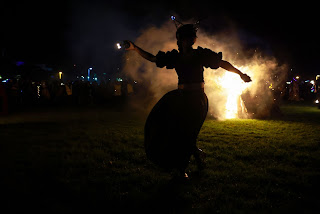
Montol is a traditional midwinter festival for the solstice, held annually in Penzance. Penglaz and other 'Obby 'Oss and mock formal folks gather for a parade, party and bonfire!
It's one of Cornwalls revived holidays - restarting in 2007 it's become a firm date in the Cornish Traditional Year. It's currently organised by the Cornish Cultural Association and the same folks organise it's opposite Golowan. As well as the Montol Parade - Montol week is 6 days of arts, crafts and community that leads up to the march. It involves the Guise Guild (those in masks and mock formal attire) and the wider Penzance community! The festival incorporates Mummers, mask-making workshops, roving bands, and more traditionally Christian Carols.
The culmination is a parade and burning of the mock yule log after beacons are lit through the town.
For every Sunday leading up to Allantide I'm going to make every effort in the world to post a blog entry detailing some specific part of Cornish folk customs around the event! Today is the function of Allan Apples in divination, along with other fun divination methods!
An Allan Apple is any highly shined, big red apple. There's no requirements beyond that! They're easy to get hold of and their use is central to Allantide! Traditionally there were Allan Apple markets where people could go and buy their apples for the festival.
Before the discussions of apples and divination it's important to confirm what Allantide is!
Allantide, also translated to Kalan Gwav (first day of winter), Nos Kalan Gwav (first eve of winter) or Dy' Halan Gwav (day of the first day of winter), is analogous to Hallowe'en or Hollantide of England and Cymru, or Samhain from Éire. As a result it's in-keeping with the themes of death, open gateways, divination and the dark of winter. More controversially (only because it divests the day and night of it's Christian attachments) it is also a festival of magic and charms. It's a particularly rich time for the appearance of ghosts, spirits and the Pobel Vean. Along with most Cornish festivals, fire and beacons are also very important.
Back to the apples - how to they factor into Allantide aside from the name? Divination...of course! The most important function of an Allan Apple was fortelling the users true love. They were generally given as gifts, so was a fairly easy affair. Older girls and young women would simply tuck the apple under the pillow during the night and sleep on it - that was enough to induce dreams of their future lover. Another more expansive use was to tell general fortune for the rest of winter, and even young children involved themselves in that.
Gifts of Allan Apples also brought luck to the receiver even if their divinatory use wasn't fulfilled!
Along with the apples, young hopefuls would throw molten lead or other metals into cold water and divine their future lovers occupation from the shapes they took - a fish would be a fisherfolk, for example. There was also the tradition of couples throwing walnuts onto an open fire to ensure their fidelity to each other throughout the coming year.
In more modern times the gifting and use of all of these divination methods fell out of favour, largely in part to increased Christianisation of Cornwall. It's starting to resurface more and more with the resurgence of folk witches and folk traditions, with apples being used as more than just divination - some offer them as gifts to ancestors passed on or as an offering to Ankow or the newly empowered Bucca Dhu.
A song has been written by a delightful Cornishwoman called Brenda Wootten and it can be found here:
Next Sunday's post will be about magic and superstition in Cornwall!
Guldize, also called Nicklydize, is a festival held near the end of September near Michaelmas and the Autumn Equinox. The date varies but is always in line with the last harvest on Farms. It's almost always accompanied with the Crying the Neck ceremony - a staple in farming communities.
It's a time when the whole community comes together and helps finish the harvest and farmers are traditionally very generous in return.
Crying the Neck was revived by the Old Cornwall Society as a ceremony, and the following explanation is given in The Story of Cornwall by Kenneth Hamilton Jenkin
“In those days the whole of the reaping had to be done either with the hook or scythe. The harvest, in consequence, often lasted for many weeks. When the time came to cut the last handful of standing corn, one of the reapers would lift up the bunch high above his head and call out in a loud voice
"I 'ave 'un! I 'ave 'un! I 'ave 'un!"
The rest would then shout,
"What 'ave 'ee? What 'ave 'ee? What 'ave 'ee?"
and the reply would be:
"A neck! A neck! A neck!"
Everyone then joined in shouting:
"Hurrah! Hurrah for the neck! Hurrah for Mr. So-and-So"
(calling the farmer by name.)"
In Kernewek that’s:
An Tregher (the reaper) – “Yma genef! Yma genef! Yma genef!”
An Re erel (the others) – “Pandr’us genes? Pandr’us genes? Pandr’us genes?”
An Tregher – “Pen Yar! Pen Yar! Pen Yar!”
An Re erel – “Houra! Houra! Houra!”
The last neck of Corn would be fashioned into a dolly - the pattern unique to the place and they hold significance in the community.
Sources -
The Cornish Traditional Year, Simon Reed (pages 26 - 36)
Goal Est (August feast), also known as Galan Est (August First) is the Cornish equivalent to Lammas or Lughnasadh. It marks the cutting of the first wheat. Celebrated every year on August 1st, there are scant records about it’s folk customs aside from Morvah Fair, where people would come from all over the county to eat and drink copious amounts.
The amount of revelry incited a priest to go on a campaign in the 19th century to ban the fair. Regrettably, it worked and there was nothing held until the 1970s. There was an effort to bring it back & strengthen the community in the form of Pasty Day - which is now an annual event held on the first Tuesday of August!
Some sources -
The Cornish Traditional Year, Simon Reed (pages 21 - 25)
Golowan is a midsummer festival and generally is held two days after the astronomical solstice & is a feast of light and rejoicing! As such, it has activities revolving around bonfires, dances and celebrations. While it was wiped out by the church at some point it has been revived in 1991 as Mazey Day in Penzance.
The Mazey Day celebrations feature a Mock Mayor election, serpent dancing and Penglaz the Penzance 'Obby 'Oss.
The Mock Mayor
Penglaz 'Obby 'Oss
Revived Serpent Dance
The firey theme is for protection from evil intentions - people jumped over fires in dances to get rid of anything hanging on. Hemp seeds were also scattered for luck and children wore wreaths of St Johns Wort. The serpent dance was and still is the staple, described by "T.J.R" thusly -
“Then comes the finale : no sooner are the torches burnt out, than the inhabitants of the quay-quarter, (a great multitude) male and female, young, middle-aged, and old ; virtuous and vicious, sober and drunk, take hands, and forming a long string, run violently through every street, lane, and alley crying “An eye! an eye! an eye!” At last they stop suddenly ; and an eye to this enormous needle being opened by the last two in the string, (whose clasped hands are elevated and arched) the thread of the populace run under, and through: and continue to repeat the same, till weariness dissolves their union, and sends them home to bed: – which is never till near the hour of midnight.”
Golowan is in part a feast for St. John, however it’s pre-christian roots may go deeper. The serpent is an aspect of Cornish folkcraft and is the familiar spirit of red magic - the magic of potency, protection and empowerment. Even the use of the word "mazey" links to the old Cornish way of getting mazed - intoxicated, entranced, maddened and frenzied.
Some sources -
The Cornish Traditional Year, Simon Reed (pages 3-20)